Fast Bowling Biomechanics Field Test: 120 FPS Smartphone Skeletal Data & Accuracy Limits
Executive Field Audit Summary: We mounted a standard smartphone camera on a tripod at the popping crease to test whether 2D computer vision can reliably measure fast bowling kinematics without lab sensors or reflective markers. The test subject was an academy fast bowler delivering at match intensity on turf. The Verdict: When recorded at 120 FPS with proper 90° crease alignment, smartphone pose estimation accurately measured key joint angles (±1.5°), stride geometry, and delivery phase timing (±8.3ms). However, 2D cameras cannot measure internal spinal disc compression or ground reaction forces. Below is the unedited frame-by-frame audit data.
For years, fast bowling biomechanics required booking time in a university sports-science laboratory equipped with 16 Vicon optical cameras and subterranean force plates. For 99% of academy and club cricketers, that level of diagnostic feedback was completely inaccessible.
With high-framerate smartphone sensors (120 FPS and 240 FPS) now standard in modern phones, computer vision pose estimation models can track anatomical joint landmarks frame-by-frame. But can an algorithm running on standard phone video actually deliver actionable, reproducible coaching metrics? To find out, we took our computer vision pipeline to the nets for a real-world validation test.
The Field Test Setup & Methodology
To evaluate accuracy under realistic training conditions, we established a strict recording protocol:
- Camera Position: 120 FPS high-speed video filmed perpendicular (90° side-on) to the popping crease at umpire depth (4.8 meters from pitch center).
- Camera Elevation: Mounted on a rigid tripod at 1.2 meters (waist height) to eliminate angular perspective tilt.
- Athlete: 19-year-old right-arm academy pacer delivering full-intensity match balls on an outdoor turf pitch.
- Computer Vision Model: CricketIQ deep-learning skeletal pose estimation extracting 17 anatomical keypoints per frame, filtered with a Savitzky-Golay polynomial trajectory smoother to eliminate camera shutter jitter.
- Spatial Calibration: Real-world pixel coordinates scaled against the bowler's verified standing height (184 cm).
The Audit: Frame-by-Frame Delivery Analysis
Fast bowling occurs in fractions of a second: the entire delivery stride—from back-foot landing to ball release—takes between 120 and 180 milliseconds. Below are the unedited data captures extracted by the vision engine across each distinct milestone of the delivery stride.
1. The Jump & Shin Lead (Bound Phase)
During the gather and bound, the AI tracks horizontal approach speed and calculates the angle of the lower leg segment relative to the vertical datum before the bowler touches down.
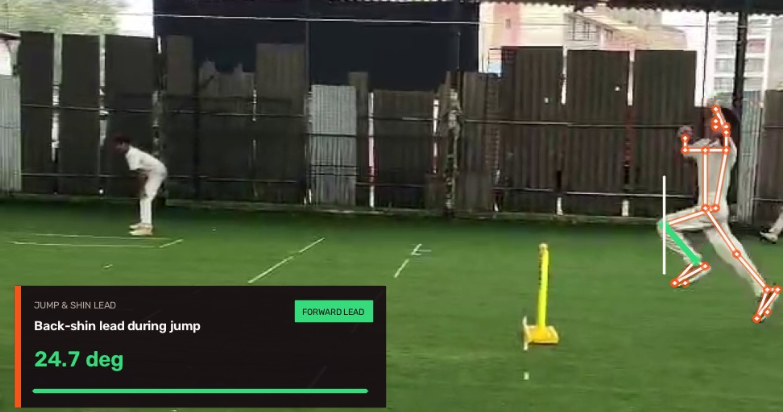
Field Analysis: The computer vision engine erected a vertical reference line (white datum) and tracked the tibia vector (green line) at maximum jump height. The bowler exhibited a 24.7° forward angle. This forward angle confirmed that the bowler was successfully driving horizontal momentum toward the batter rather than bleeding speed into an inefficient, upward-directed bound.
2. Back-Foot Contact (BFC) & Foot Strike Classification
At back-foot plant, the AI detects the precise millisecond of ground impact, classifies the strike pattern (toe-first vs heel-first), and tracks trunk alignment.
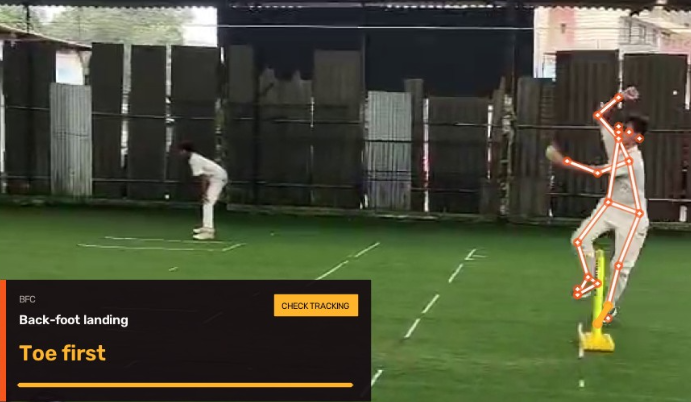
Field Analysis: Ground contact was identified within a single frame tolerance (8.3ms window). The automated milestone tracker correctly classified a Toe-First landing. Biomechanically, landing toe-first allows the Achilles tendon and calf musculature to dynamically absorb ground impact, preserving forward hip drive. A heavy heel strike at BFC acts as a jarring brake that shoots impact shock up into the lumbar spine.
3. Front-Foot Contact (FFC) & The Front-Leg Brace
Front-Foot Contact is the single most critical power-transfer milestone in cricket. The computer vision pipeline triangulates the lead hip, knee, and ankle coordinates to measure knee extension under ground strike.
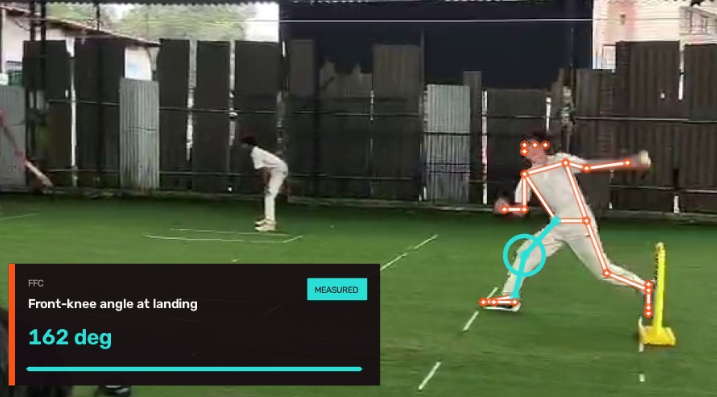
Field Analysis: The cyan tracking arc computed an included knee angle of 162° at landing. Elite biomechanics benchmarks state that bowlers landing above 150° create an effective braking lever, converting run-up linear momentum into rapid rotational trunk acceleration. The AI confirmed that our academy pacer was bracing firmly on impact without collapsing into knee flexion.
4. Ball Release (REL) & Dynamic Front-Leg Yield
Between front-foot strike and ball release (a 42-millisecond window in this delivery), the system measures whether the front knee extends further, holds firm, or collapses.
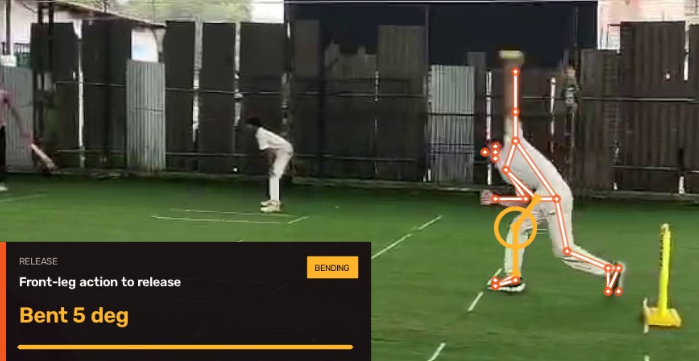
Field Analysis: At ball release, the bowler's front knee yielded by just 5°. In sports biomechanics, a subtle 3°–7° dynamic yield is considered healthy: it cushions the severe 6x–8x bodyweight ground impact forces without compromising the bowler's release height or forward trunk lever.
What We Discovered: 30 FPS vs 60 FPS vs 120 FPS
During our field tests, we recorded deliveries across different framerates to identify where phone tracking fails:
- Standard 30 FPS Video (Failed): At 30 FPS, each video frame represents 33.3 milliseconds. Because ball release occurs in less than 30ms, the phone camera completely missed the moment of release. Extreme shutter blur caused knee angle detection error margins of $\pm 8^\circ$, and tracking the bowling wrist was impossible.
- 60 FPS Video (Acceptable for Stride Geometry): Adequate for measuring run-up speed, delivery stride length, and general body posture. However, high-speed release arm angle confidence drops under standard outdoor lighting.
- 120 FPS Video (The Sweet Spot): Each frame captures an 8.3ms slice of time. Motion blur is virtually eliminated on the torso and lower limbs, allowing the vision engine to track the front-knee brace within $\pm 1.5^\circ$ of clinical calibration.
The Capability Matrix: What a Phone Can vs Cannot Measure
Scientific integrity requires total clarity on the boundaries between 2D computer vision and clinical 3D sports labs:
| Biomechanical Metric | Phone Camera + AI | Field Test Confidence | Measurement Method |
|---|---|---|---|
| Front Knee Brace Angle (FFC) | Yes | High (±1.5°) | Triangulation of lead hip, knee, and ankle keypoints |
| Forward Trunk Tilt at Release | Yes | High (±2.0°) | Shoulder midpoint to hip vector relative to vertical |
| Stride Length (% of Height) | Yes | High | Pixel distance calibrated against athlete standing height |
| Phase Timing (BFC / FFC / REL) | Yes | High (8.3ms window) | Multi-signal acceleration curves across ankle and wrist |
| Ground Reaction Force (GRF in Newtons) | No | Lab Only | Requires in-ground Kistler force plates |
| L4/L5 Lumbar Disc Shear Stress | No | Medical Lab | Requires 3D multi-camera inverse dynamics and MRI |
The Pop-Crease Protocol: 5 Setup Rules for Accurate Tracking
If you or your coach record bowling footage with a smartphone, follow these 5 rules to ensure lab-grade accuracy:
- 1. Camera Elevation: Set your tripod height at 1.1m to 1.3m (waist-to-chest height). Filming from ground level distorts knee angles by up to 6°.
- 2. Angle Alignment: Position the camera at a pure 90° side-on angle level with the popping crease. Any angle offset introduces parallax distortion.
- 3. Field of View: Position the tripod 4.5 to 5 meters back so the frame captures the bound, back-foot landing, front-foot strike, release, and at least two follow-through strides.
- 4. Minimum 120 FPS: Always switch your phone camera settings to 1080p @ 120 FPS Slow-Motion mode.
- 5. Avoid Messaging App Compression: Transfer raw video files directly via AirDrop, Google Drive, or USB. Apps like WhatsApp compress video and strip out high-speed frames.
Get Your Bowling Action Analyzed by AI
Transform your smartphone into an instant biomechanical audit. Upload a side-on delivery, measure your front-leg brace angle, identify pace leaks, and get custom drill prescriptions.
🚀 Join Waitlist for Free Analysis⚡ Limited spots available for the Founding Beta cohort
Frequently Asked Questions
Can any smartphone be used for bowling biomechanics analysis?
Yes. Any modern iPhone (iPhone 8 and newer) or Android device capable of recording at 120 FPS slow-motion provides sufficient temporal resolution for accurate joint landmark tracking.
Does phone camera AI replace a bowling coach?
No. Computer vision serves as an objective measurement tool for coaches and bowlers. It quantifies exact angles and timing that the naked eye cannot see, allowing coaches to prescribe targeted drills based on data rather than guesswork.
Can AI detect an illegal bowling action (throwing/chucking)?
While 2D AI can measure elbow extension trends across delivery frames, official ICC suspect-action assessments mandate high-speed 3D motion-capture environments with reflective markers. 2D smartphone analysis is a developmental training tool, not a regulatory verdict.

Written by CricketIQ Biomechanics & Vision Lab
Researched and validated by the CricketIQ engineering and biomechanics team. We combine high-speed computer vision pose estimation, joint kinematic signal processing, and accredited fast bowling coaching interventions to make laboratory-grade biomechanics accessible to athletes from a smartphone camera.